
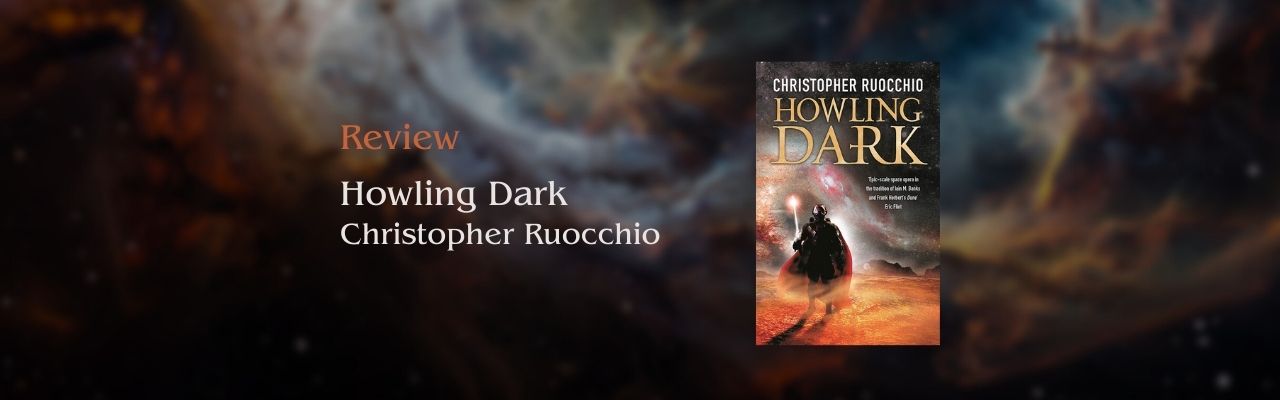
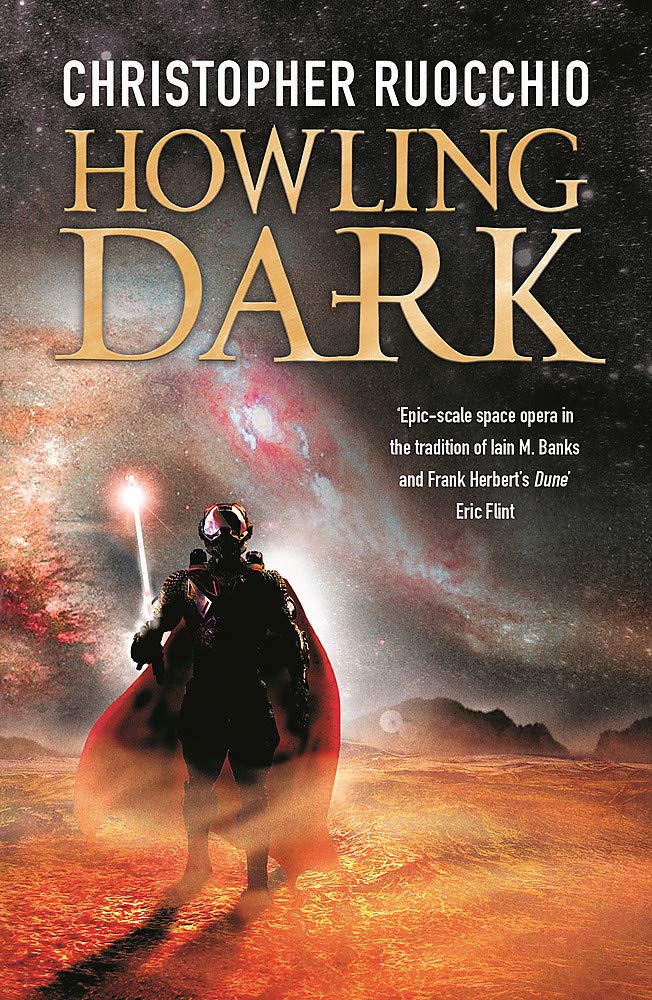
Christopher Ruocchio’s Sun Eater series is often compared to Dune or The Name of the Wind, but with the release of the second volume, it has carved out a dark, bloody niche all its own. In this Howling Dark review, we look at a sequel that is wider in scope, more imaginative in its horrors, and significantly more challenging in its character study than its predecessor.
I had some issues with the first book Empire of Silence, specifically around the sometimes meandering pacing, along with how unlikable the protagonist was. Whilst Howling Dark solves the pacing issue for me, it actually doubles-down on the unlikability of the protagonist…but this time, I feel like I appreciated the intent of the author far more.
Verdict at a glance
Rating: ⭐⭐⭐⭐ (4/5)
Genre: Epic Space Opera / Science Fantasy
Perfect for: Readers who loved The Name of the Wind but wished Kvothe was a bit more of a xenophobic disaster, or fans of Dune who want more visceral, body-horror action.
The “Whiplash” of the Time Jump
Let’s address the elephant in the room: the first chapter is a total shock to the system. I actually had to check if I’d missed a novella (chronologically, I didn’t, but Ruocchio has filled in the blanks in between with The Lesser Devil, published after Howling Dark). We jump nearly fifty years into the future, leaving behind almost everything familiar from Empire of Silence. At first, it’s a hard pill to swallow. You’re asking yourself, “Where is the crew? Who is Admiral Whent? Why am I suddenly a mercenary captain?”
But once you hit the “lock-in” moment around chapter five, you realise that Ruocchio isn’t just skipping time; he’s showing us that in this universe, time is the ultimate antagonist. This Howling Dark review wouldn’t be honest if I didn’t admit that the scale of this series is terrifying. The way Hadrian treats decades like weeks tells you everything you need to know about his detachment from the “normal” human experience. Or is this just a symptom of living in this space-faring universe?
Hadrian Marlowe: The Man I Love to Hate
I’ve spent a lot of time thinking about Hadrian’s character arc, and honestly? He’s kind of a nightmare. He’s the world’s worst spy, constantly getting read like an open book by everyone from the Painted Man to M. Brevon. But that’s not why he’s difficult. He’s difficult because he’s a hypocrite.
He spends the whole book acting like his “Palatine blood” is sacred while happily trading away the lives and blood of others. He’s a product of the Chantry: bigoted, xenophobic, and deeply uncomfortable with anything “impure.” Even as he travels with the Extrasolarians, he can’t seem to shake that disgusting elitism. He accepts Valka, sure, but only because he has a personal stake in her. Everyone else? He views them with a physical revulsion that is genuinely jarring to read. It then becomes an ironic sense of justice that the climax of the book results in Hadrian losing an arm, only to need it replaced with an artificial limb of his own to force him to confront that flesh-purity through the rest of the series.
What makes this a great book though, is that Ruocchio doesn’t ask us to like him. He’s using the “unreliable narrator” trope to perfection. Hadrian is writing this as a memoir, weaving his acts of ego-driven violence into these high-brow philosophical diatribes. He’s trying to convince us (and himself) that he’s a philosopher-king, yet it’s plain to us that his actions only scream “narcissist.”
I had numerous issues with this style of narration and Hadrian’s personality, in the first book Empire of Silence, and whilst it is no different in Howling Dark, I feel as though it’s finally “clicked” with me. In Howling Dark, I get it. This memoir is Hadrian’s attempt to elevate himself above the horrors he commits, to warp history to match his internal ego. Once you have that realisation, and start to view the events and the style of narration with a healthy dose of cynicism, it becomes far more enjoyable to read.
The Horrors of Vorgossos and the Exalted
The world-building in the second half of the book is where things get truly weird. The Exalted are a stroke of genius—a terrifying escalation of everything Hadrian hates about homunculi. When they reach the city on Vorgossos, the atmosphere shifts into something out of a gothic nightmare. It reminded me of a desolate, space-faring version of Eulmore from Final Fantasy XIV (great game, play it)—a place where nobles indulge in their whims while serving a “god” they don’t even begin to understand.
Meeting Kharn Sagara was a massive turning point for me. Up until then, the “big bads” felt like cosmic forces. But Sagara is petty and manipulative in a way that provides Hadrian a sort-of mirror of who he will eventually become. He’s essentially a bored immortal playing with toys. Seeing him possess the concubine Naia—a character whose existence is so heartbreakingly sad—was the moment I realised this series isn’t just about a war with aliens; it’s about the moral decay of humanity itself.
The Mythological Mystery
The deeper Ruocchio goes into the mystery of “the Quiet” and the Cielcin, the more the story takes on this grand, mythological quality. The scene with the Oracle on the Exalted ship—telling Hadrian his “past is broken”—is the kind of sci-fi mystery that keeps you up at night. We’re learning more about the universe, yet somehow, we know less than ever. It’s a brilliant balancing act.
A rough-cut diamond
I appreciate so much about this book, but unfortunately, it’s not all positive. The bureaucratic arguing between Hadrian and Bassander Lin felt like it dragged. We know Hadrian isn’t going to follow orders, so watching them bicker over whether they were going to rejoin the fleet or not felt a bit like filler. Also, the “diary” format means Hadrian occasionally spoils his own story. He’ll be considering whether or not to take a ‘deal’ at the end of a chapter, then in the final line, he’ll narrate, “If only I had taken the deal, I would have saved millions of lives,” thereby robbing the upcoming scene of its tension.
I also have some concerns around time skipping. Ruocchio seems to suggest that it took them seven years of being in fugue to get from Rustam to March Station, yet later on, at Vorgossos, a communication from Switch is able to summon Bassander Lin’s forces to the planet in a mere few months. Then later, Lin is able to summon the full might of his superior’s forces to the Cielcin negotiation in record time. Can we put this down to unreliable narration, my misunderstanding as a reader, or a flaw in the author’s ability to correctly communicate the time/distance issue? Honestly, it could be any of the above.
Final Thoughts: A Villain in the Making?
By the end of this book, I was convinced: Hadrian doesn’t actually want peace. He wants to be the man who brought peace. There’s a massive difference. He wants greatness above all else. When he kills the child Nobuta just because his pride was hurt, he proves he’s a coward hiding behind a sword. He’s cruel to Switch, he’s selfish with Jinan, and he’s becoming a villain in real-time.
Is it a masterpiece? It’s close. It’s visceral, immediate, and intellectually demanding. If you can handle a protagonist who makes you want to scream, you’ll find one of the most rewarding sci-fi experiences of the decade here.
This Howling Dark review is my way of saying: I hate Hadrian Marlowe, and I can’t wait to read the next book.