
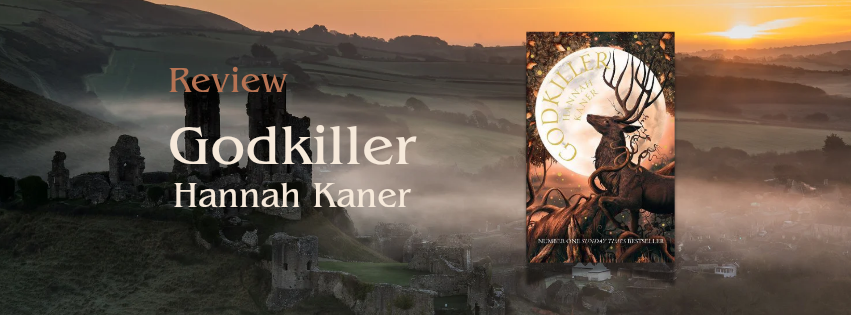
Review Contains Spoilers.
Rating: 3/5
In the crowded landscape of modern fantasy debuts, Godkiller by Hannah Kaner stands out with a killer premise: Gods are not distant myths, but tangible manifestations of human belief that walk the earth.
While the novel delivers a refreshing take on divine magic and features a gritty, lived-in world, it isn’t without its flaws. In this review of Godkiller, we break down the highs of its world-building and the lows of its pacing and character dynamics.
The World of Godkiller: A Lived-In Fantasy
The strongest selling point of Godkiller is undoubtedly its setting. Kaner has crafted a world that feels genuinely historical and weighty. Unlike many fantasy debuts that feel like thin veneers over standard tropes, the world of Godkiller feels “lived in.”
The core magic system is particularly compelling. The concept that Gods rise and fall specifically because of the collective belief of the people adds a fascinating layer of sociology to the magic. It grounds the supernatural elements in human psychology, making the stakes feel personal rather than abstract.
What Works: Twists and Divine Agency
Beyond the setting, there are key narrative moments where Godkiller shines brilliantly.
The Twist You Won’t See Coming
Unexpected storytelling is rare in the genre, but the revelation regarding Elogast’s curse was a standout moment. Just when the story seemed to be settling into a predictable rhythm, this twist subverted expectations perfectly. It added a layer of tragedy and complexity that felt earned rather than cheap, breathing new life into Elo’s arc.
Skedi and Inara: The Highlight
The dynamic between Inara and Skedi—her “god of white lies”—provided the book’s best character work. Specifically, the sequence where Skedi takes over Inara’s body was a high point in the narrative.
- It finally gave the God agency beyond simply being a companion.
- It allowed Inara to showcase her resilience and talent by fighting to push him out.
Where Godkiller Struggles: Pacing and Structure
Despite the strong setting, Godkiller suffers from significant pacing issues, particularly in the first act.
The story takes a considerable amount of time to find its footing. Readers must push through a lot of setup before the plot gains momentum. In fact, the first moment of genuine character tension—when Elo reveals to Kissen that he knows who she is—doesn’t occur until roughly the 40% mark. For a book promising god-killing action, the early burn is perhaps too slow for some readers.
The Problem with the Romance
A major point of contention in this review is the relationship between the protagonist, Kissen, and Elogast. The burgeoning romance feels forced and, at times, illogical.
The pivotal “lakeside scene,” presumably intended to build intimacy, falls flat. The narrative suggests that Kissen—a hardened Godkiller who has spent her life surviving on the road—needs Elogast to help her warm up. This feels contrary to her established competence. It doesn’t read as Kissen being deliberately vulnerable; rather, it feels like an afterthought by the author to push Elogast into a “carer/lover” role. Consequently, the attraction lacks believability.
Character Arcs: Who is the Real Protagonist?
Strangely, the “B-plot” characters (Inara and Skedi) often feel more compelling than the main heroes. Kissen, despite being the titular archetype, lacks a focused arc. Her story feels incidental; she simply happens to stumble upon her greatest enemy at the conclusion of Elogast’s quest, rather than driving the narrative herself.Furthermore, while it becomes clear that Inara is a God, the lack of stronger revelations regarding her parentage and true nature feels like an omission rather than a mystery.
Final Verdict: Is Godkiller Worth Reading?
Godkiller by Hannah Kaner is a book of great ideas situated in a fantastic world. However, it is hampered by a slow start and a protagonist who often feels like a passenger in someone else’s story.
If you love deep lore and unique magic systems, it is absolutely a worthwhile read. However, if you are looking for fast-paced action or a naturally developing romance, you may find the journey a bit uneven.