
The landscape of epic fantasy is often crowded with familiar tropes, but every so often, a novel arrives that completely recalibrates our expectations. In this The Will of the Many review, I’ll be exploring why James Islington’s latest release is being hailed as one of the most significant entries in the genre this decade. Moving away from the traditional tropes of his previous work, Islington has delivered a narrative that is as intellectually rigorous as it is emotionally resonant.
The Verdict at a Glance
Rating: ⭐⭐⭐⭐⭐ (5/5)
Genre: Epic Fantasy / Dystopian
Perfect for fans of: Fans of Red Rising, The Name of the Wind, and readers who love complex, tiered magic systems and “Dark Academia” settings.
A Society Built on Ceded Will
At the heart of the Hierarchy is the concept of ‘Will’. This is not just a metaphorical drive; it is a tangible energy, that can be ‘ceded’ to those higher up the social ladder. This creates a literal tiered society where those at the top possess superhuman capabilities fueled by the life force of those below them. It is a chillingly efficient system of governance that provides the perfect backdrop for a story about rebellion and morality.
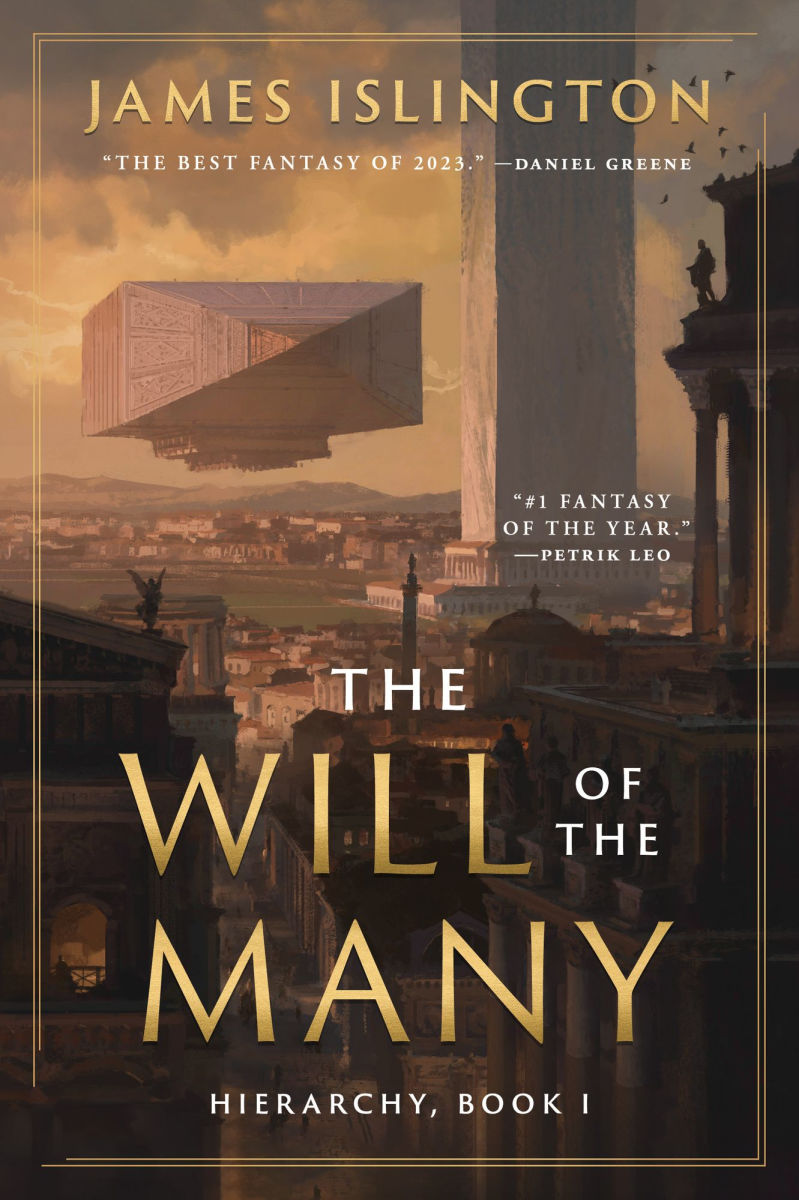
The Roman-inspired world-building is masterfully handled. While the cultural foundations feel ancient, the integration of Will-powered technology, such as the Transvects for air travel, pushes the setting into a unique industrial age. It feels lived-in and logical, providing a grounded sense of place even when the mythology begins to skew toward the supernatural.
The Catenan Academy and the Path of Vis
Our protagonist, Vis, is the adopted son of a senator, sent to the elite Catenan Academy to uncover the mysteries of the Hierarchy from the inside. The “dark academia” elements here are stellar. The curriculum is gruelling, and the competition is murderous. Because the story is told from a first-person perspective, we are privy to every one of Vis’s internal conflicts as he navigates a system he finds abhorrent, yet must excel within to survive.
One of the greatest strengths of the narrative is the ambiguity of the supporting cast. Much like Vis, the reader is never quite sure who to trust. Whether it is the cryptic Principalis, Veridius, or his adoptive father, Senator Ulcisor, every character feels like they are playing a long game. This uncertainty drives the tension forward, making every interaction feel like a high-stakes chess match.
Escalating Stakes and a Reality-Shifting Climax
What begins as a focused critique of a tyrannical regime slowly expands into something much grander. Throughout this The Will of the Many review, I have tried to convey the scale of the world, but the final chapters truly take it to another level. The Iudiceum and the disaster at the Naumachia are standout set pieces, but it is the final pivot in scope that truly impressed me.
Islington masterfully weaves threads about a greater mythology involving “three worlds.” In the final moments, the stakes shift from the “earthly” concerns of a political revolution to a cosmic threat that puts the entire world at risk. It is a bold narrative move that pays off, leaving the reader reeling from the implications of the broader universe Islington is building.
Navigating a Complex Conclusion
If there is any criticism to be levelled, it is that the execution of the ending is incredibly dense. The revelation regarding the nature of world is mind-blowing, but it requires the reader’s full, undivided attention. In my experience, I had to revisit the epilogue several times to ensure I hadn’t missed a crucial detail, particularly regarding the state of our protagonist.
However, this complexity is a testament to the depth of the world Islington has created; it isn’t a book that holds your hand, and it is all the better for it. This The Will of the Many review would be remiss if it didn’t mention that the audiobook version, in particular, might benefit from a physical copy nearby to help digest those final, reality-bending moments (most notably, because the narrator doesn’t properly give an indication that a scene-break has occurred).
Final Thoughts
The Will of the Many is a triumph. It balances high-octane action with deep philosophical questions about power, consent, and the cost of order. James Islington has proven that he is not just a great storyteller, but a world-builder of the highest calibre. If you are looking for a story that combines the political bite of Red Rising with the mythological depth of classic epic fantasy, this is your next must-read.